Short answer: on 9 July 2026, OpenAI merged the Codex app into the ChatGPT desktop app for Mac and Windows. Codex keeps its own view and history next to Chat and Work, and your Codex threads, login and settings are where they were, in ~/.codex. What didn't change: the app still signs in one account at a time. Sessions Pro for Codex runs each of your accounts as its own copy of the app, all signed in at once.
Free 1-hour preview once you've signed in to a profile. For macOS 14 or later, or Windows 10 or 11, with the ChatGPT desktop app.
What changed
- One app, three views. OpenAI's release notes say Codex joined Chat and Work in the ChatGPT desktop app, keeping its dedicated coding view and its own history.
- Existing users update as usual. If you had the Codex app, it updates to the ChatGPT desktop app. You can make Codex the default view and keep the Codex icon.
- Every plan. OpenAI says the updated desktop app is available on every ChatGPT plan, Free included, on Mac and Windows.
Where your Codex work is now
Under the new name, it's still the same app. On a Mac, /Applications/ChatGPT.app still carries the bundle ID com.openai.codex, and its data is still in folders named after Codex:
| Mac | Windows | |
|---|---|---|
| The app | /Applications/ChatGPT.app | ChatGPT from the Microsoft Store (package OpenAI.Codex) |
| App data | ~/Library/Application Support/Codex | %APPDATA%\Codex\web\Codex |
| Codex login, threads, settings | ~/.codex | %USERPROFILE%\.codex |
The Codex CLI didn't move either: codex still uses ~/.codex, so by default the app and the CLI share one login. Where Codex stores your login has the details, and codex app opens the desktop app from the terminal.
What didn't change
The app still holds one ChatGPT account at a time. Signing in to a second account replaces the first, so moving between a work and a personal account still means logging out and losing your place in your Codex threads. OpenAI's account switcher only works on the web version, which doesn't help if you build real projects in the desktop app.
Every account, its own ChatGPT app.
Sessions Pro for Codex runs the ChatGPT desktop app you already have once per account. On a Mac each profile is its own app with its own Dock icon, colored badge and menu bar switcher; on Windows each runs in its own window, titled with its profile name, with its own taskbar button. All of them stay signed in, so there's nothing to switch.
Each keeps its own login, chats, Codex threads, projects and pins, and "Codex CLI in Terminal" opens the CLI on the same account. It starts from your current ChatGPT, so nothing is lost. Try it free for an hour once a profile is signed in; then it's $24.99 once for two computers, Mac or PC, with a 14-day refund.
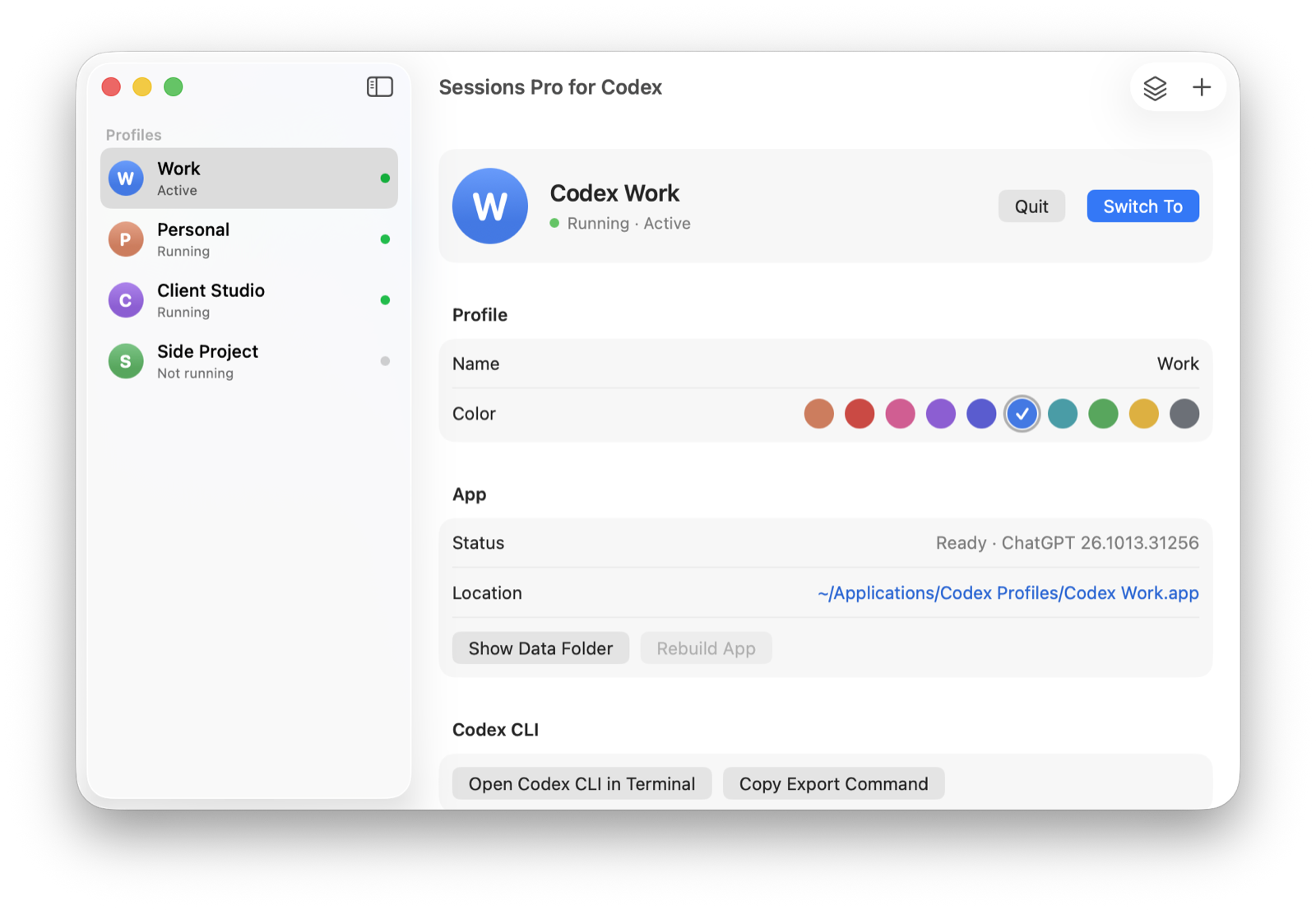
We make Sessions Pro for Codex.
 Sessions Pro for Codex
Free 1-hour preview · 14-day refund · 2 computers, Mac or PC
On a Mac, see every way to run several ChatGPT and Codex accounts; on Windows, multiple ChatGPT accounts in the Windows desktop app.
FAQ
What happened to the Codex app?
On 9 July 2026 OpenAI merged it into the ChatGPT desktop app for Mac and Windows. Codex keeps its own view and history alongside Chat and Work, and existing Codex app users update as usual.
Are my Codex threads and login still there?
Yes. The app still keeps its Codex data in ~/.codex (%USERPROFILE%\.codex on Windows), the same folder the Codex CLI uses, so your threads, login and settings stay where they were.
Can I use two accounts in the new ChatGPT desktop app?
Not in one copy: it signs in one account at a time, and OpenAI's account switcher only works on the web version. Sessions Pro for Codex runs each account as its own copy of the app, all signed in at once.
Sessions Pro for Codex is made by LEX GLOBAL IT S.R.L. and is not affiliated with, endorsed by or sponsored by OpenAI. It runs the official ChatGPT app with accounts you already have, and OpenAI's terms apply to each account. ChatGPT and Codex are trademarks of OpenAI.